
Sessions with the Farmer’s Wife:
Conventional Wisdom for Contemporary Life
March 26, 1981: John worked Ellerbroek quarter & then moved to Callenius land south of highway. Jim had early jazz band practice & then came home to run some errands for John & help unload some seed beans. – Leona, Personal Journal

Why do generic photos elicit such strong memories & emotions?
Every year I was in elementary school we were required to take a standardized test called the Iowa Tests of Basic Skills. With a title like that, it’s no mystery what the purpose of the tests was – to see how competent students were at what was (and still is) considered basic skills of education. Today we begin a series of what I deem to be the basic skills of life. Lack of knowledge, understanding or performance of one or more of these foundational concepts is what oftentimes introduces me to my clients. Just like knowledge is far more complex than what was assessed on the ITBS, living life well is far more complicated than just these ideas. However, if you gain proficiently in these basic skills, many aspects of life are much easier than they would be without that ability.
Today’s concept number one is what is commonly referred to as boundaries. Boundary issues get us into all sorts of confusing and convoluted conversations, conditions and circumstances. Perhaps the best resource for this discussion is the book Boundaries (2001) by Drs. Henry Cloud and John Townsend. They state, “Boundaries define us. They define what is me and what is not me. A boundary shows me where I end and someone else beings, leading me to a sense of ownership.” A simple farm analogy is the fence. Fences do the exact same for farmers that boundaries do for individuals. As you can see in Leona’s entry, John was driving his farm equipment around two pieces of land that are named, have location, and have specific dimensions. Although this entry is from 1981, I guarantee you that we could travel to northwest Iowa this afternoon and find these exact same tracts of land. Even if the fences are different or gone, the boundaries are exactly the same – 30 years later.
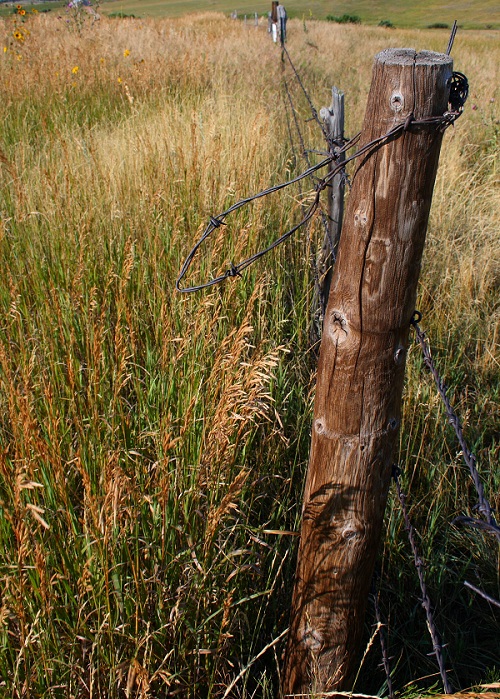
This Old Fence Still Makes Its Intentions Known
Here are a few principles to take away from this farming analogy:
1) The fence line – or boundary – gives definition as to where the farmer is supposed to be, where his farm begins and ends.
2) The fence line provides freedom for the farmer to do what he wants with his own land.
3) The fence line provides safety and security since government and legal entities will intervene if anyone violates the farmer’s land.
4) The fence line encourages responsibility by the farmer for his land to select seeds, fertilizer, herbicides, tillage, weed treatment and many other options for his crop. He has the right to do nothing or something else with his land, as long as his choices don’t violate land regulations and zoning.
5) The fence line prevents encroachment attempts and disputes, thus providing peaceful farming.
6) Peaceful farmers encourage a safer, more strongly connected community.
7) Fence lines provide some protection for our land and our crops. Driving across a section of land isn’t such a great idea once you run into a fence.
8) If the farmer wants someone else on the land, he can either open the gate for them or give them permission to be on his land.
What other principles can you assimilate from this farming analogy of fences? I encourage you to go back through this list and read them one by one, then make the translation from the farming idea to your life. For example, #1: The fence line gives definition as to where the farmer is supposed to be, where his farm begins and ends. Are you aware, as an individual, where you are, where you begin and where you end? Are you aware of who you are not and who is not you? If not, I expect you are telling someone else how to live their life while you pay very little attention to how you are living your own life. Or, perhaps someone else is telling you how to live your life and you take no responsibility for your own existence. Your fences are down; you need to take some measurements and rebuild them.
While some fields have strong solid fences, occasionally more secure than what a corn field really requires, a lot of fields have no fences at all. These are both boundary concerns. One has too many limitations; the other doesn’t have enough. Cloud and Townsend identify four types of boundary problems:
1. Compliants: These folks say “yes” to the bad; their gate swings open to everything. Often because of the fears related to saying, “No,” Complaints suffer much turmoil. Once they are given permission to express their disagreement or dislike, Compliants can gain possession of their personal property – their own life!
2. Avoidants: A brick wall approach creates the opposite issue, saying “No” to the good! Avoidants don’t let anyone in to their life. They may be unable to ask for help or to recognize their own needs. Avoidant behavior is often taught through the example of parents or learned as a survival skill from an abusive life.
3. Controllers: These people have an opinion about everything and intend to have everyone know and follow their preference. You can scream, “NO!” at a Controller, and he or she will just keep right on as if you never made a sound. Somehow, they are responsible for everyone’s life – everyone’s but their own!
4. Nonresponsives: A Nonresponsive cannot hear, see or accept the needs of anyone else. They tend to be completely self-absorbed with no intention of realizing or succumbing to the wishes of anyone else. They don’t need you to do anything; just don’t bother them with your “trivial” preferences or problems.

My Flowers are Doing Their Best to Work with Spring!
There are a couple more ideas I’d like to present before we move on to the next basic skill, but this is plenty to chew on for today. Take some time to go back through these ideas. I expect everyone has a boundary issue of some sort in his/her life at one time or another. How does all of this relate to you, your life, your relationships? Are you a “boundary problem”? If so, it’s a great time to get these fence lines measured out. That’s what early Spring is all about – getting everything in line so we can do our best to sow a bumper crop this year!
Grain of Truth: Boundaries define what is me and what is not me. A boundary shows me where I end and someone else beings, leading me to a sense of ownership.


 Sessions International